

- 00000018WIA306E1970GYZ
- id_400225031.2
- May 26, 2022 12:47:44 AM
Cardiac Gating/Triggering
Cardiac Gating/Triggering is used for:
- imaging the heart’s structure and function
- imaging in the thorax
- Cine-PC arteriography to examine flow
There are two types of gating/triggering:
- ECG: uses the heart’s electrical activity as reported by the ECG. Electrode placement is critical to a successful ECG scan. Adjust the electrodes until a strong signal is received. If the signal is lost during the acquisition, it will abort the scan.
- For details, see ECG gated exam procedure.
- Peripheral: uses a photopulse sensor that picks up the mechanical action of blood pulsing through the body.
- For details, see Peripheral gated exam procedure.
Cardiac Triggering is best suited for acquiring T2-weighted images. Cardiac Gating is best suited for uniform, short TR scans.
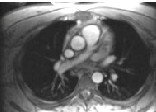
Peripheral Gating is used for head, cervical, and thoracic spines to minimize pulsatile motion of CSF on T2*- or T2-weighted scans. It is safe for patients due to the fiber-optic technology.
Gating
Cardiac Gating acquires data continuously at the operator-selected TR. Data acquired between user-defined Trigger Windows and after a user-defined delay may be used for image creation.
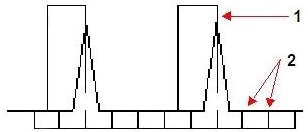
| Number | |
|---|---|
| 1 | Trigger Window |
| 2 | Uniform TR |
Triggering
Cardiac Triggering is a process by which data acquisition is initiated when a trigger of some type is detected.
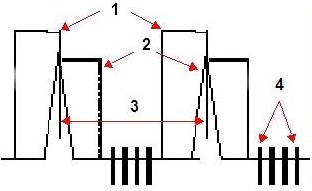
| Number | |
|---|---|
| 1 | Trigger Window |
| 2 | Trigger Delay |
| 3 | RR Interval |
| 4 | Slices |