

- 00000018WIA30462980GYZ
- id_20352011.8
- Jun 29, 2022 1:27:05 PM
Emergencies
- Cradle emergency release and re-engagement
- Patient emergencies
- Emergency stop and abort scan
- Emergency off
- PDU main breaker
- Equipment or environmental emergencies
- Safety review
You must become very familiar with the location and proper use of certain emergency buttons and releases should an emergency occur in the MR environment. Advanced planning and being accustomed to your site’s procedures and surroundings are necessary to ensure a safe environment.
Before you begin any scanning procedure, explain the use of the Patient Alert System to your patient. Make sure he or she understands its purpose and use. Remember that implants, pacemakers, and ferromagnetic life-support systems cannot be brought into the magnet room.*
Be sure to closely monitor patients with a increased potential for cardiac arrest or claustrophobia, or patients who are unconscious or extremely ill. Always maintain visual contact with the patient. Be familiar with your site’s predetermined location outside the magnet room where you can transfer patients if it becomes necessary for emergency personnel to intervene.
The figure below displays a general layout of an MR magnet room. You should always be able to maintain visual contact with your patient from the operator’s console.
*In general, patients with conductive (e.g. metallic) implants are contraindicated for MR scans. Some implantable devices have been labeled as MR Conditional under certain operating conditions. Only use quadrature transmit for MR Conditional devices. MR Safe implants will have the MR Safe symbol in their implant documentation.
When evaluating whether to proceed with MR scanning on patients with such implants, consult the implantable device’s labeling.
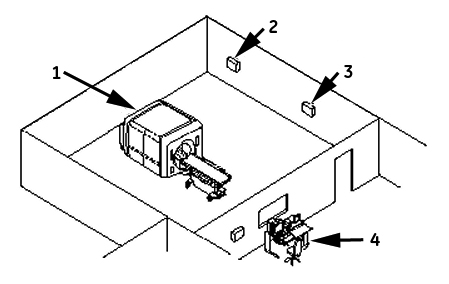
| Number | Description |
|---|---|
| 1 | Magnet and magnet enclosure |
| 2 | Oxygen monitor remote sensor (optional) |
| 3 | Emergency magnet rundown |
| 4 | Operator's console |