
- 00000018WIA30A02970GYZ
- id_400233281.3
- Aug 18, 2022 2:31:24 PM
IR Prepared
IR Prepared applies a 180° RFIR preparation pulse to enhance T1-weighting and to suppress signals from selective tissues. The initial 180° RF pulse is followed by a waiting period (prep time), where the desired contrast is allowed to evolve before the RF excitation pulse is applied. The prep time allows longitudinal magnetization (T1) differences to occur, similar to the 180° inversion pulse in an IR sequence. Centric phase encoding is used to take advantage of the contrast that evolves during the prep time before a steady state condition develops.
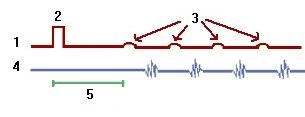
| Number | Description |
|---|---|
| 1 | RF |
| 2 | 180 |
| 3 | excitation pulses |
| 4 | echo |
| 5 | prep time |
Use the IR Prepared Imaging Option to enhance T1-weighting and to suppress signals from selective tissues.
| Warning | |
|---|---|
- Use longer prep times as field strength increases. IR Prep times:
- Abdomen: 500 to 600 ms
- Cardiac: 200 to 300 ms
- Liver: 200 to 400 ms
- Fat: 80 to 130 ms
- Spleen: 400 to 600 ms
- CSF: 700 to 800 ms
Figure 2. Abdomen with IR Prepared 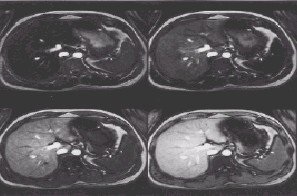
- When IR Prepared is selected, a Prep Time field is available on the Details screen. When you select Auto from the Prep Time menu, then Auto Prep Time displays next to the text field.
Figure 3. Prep Time menu 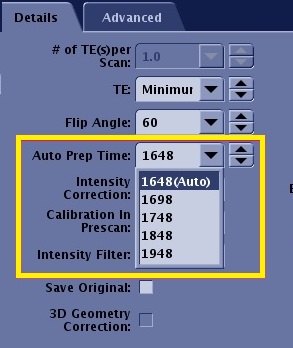
- Some degree of blurring may occur due to varying amounts of T1 relaxation as the protons recover from the initial 180° prep pulse. Centric phase encoding helps to reduce blurring.
- 2D Fast TOF GRE/SPGR and Fast GRE/Fast SPGR with Sequential and IR Prepared results in the following:
- The inversion pulse is non-selective, resulting in more consistent vascular suppression.
- IR-Prep uses sequential versus centric phase encoding resulting in optimized liver/spleen contrast.
- The prep time calculation is independent of the matrix size.
- The above does not apply for IR-Prepared with cardiac gated PSDs or 3D applications.
- For 2D Fast TOF GRE/SPGR or Fast GRE/SPGR only, the prep time is calculated from the inversion pulse to the acquisition of the center of k-space, which is where the contrast is determined. This calculation method is designed to optimize liver/spleen contrast.
- For 2D Fast GRE-ET sequences, the TI is automatically calculated based on the other sequence parameters.
- The TI is generally in the range of 150 to 175 ms when 0.75 PFOV is selected.
- Otherwise, the TI is > 230 ms, causing poor fat suppression.