

- 00000018WIA30302970GYZ
- id_400249121.4
- Aug 18, 2022 2:13:17 PM
IDEAL
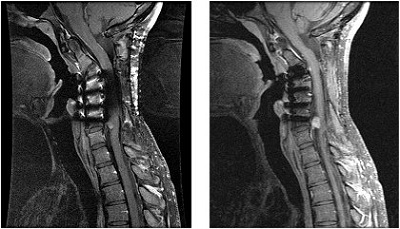
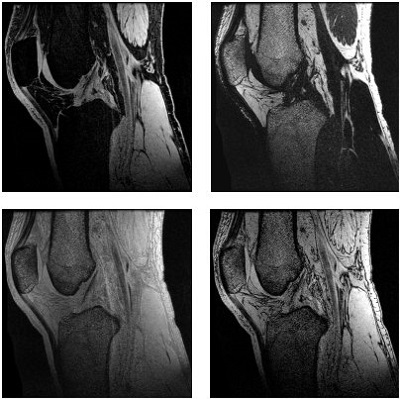
IDEAL uses a three-point Dixon method to acquire multiple echoes resulting in water only, fat only, fat and water in-phase, and fat and water out-of-phase processed images.
Although IDEAL can be used in any anatomical area, it is particularly useful in extremity and spine imaging. Indications for use include: C-spine, knee, foot and ankle, and brachial plexus.
Details
In the presence of magnetic field inhomogeneities, the resonant frequency shift of fat and water typically varies over the image volume. In normal chemical suppression techniques such as fat SAT, areas of inhomogeneity result in poor fat suppression. IDEAL is designed to improve fat suppression in small FOVs and when the FOV is offcenter. This is accomplished by pre-shifting the computed fat image (correct to even sub-pixel dimensions using the Fourier transform shift theorem) before doing the addition and subtraction to synthesize the in- and out-of-phase images.
As a result, the dark line edges between water/fat boundaries that are associated with chemical shift (increased pixel shift) are eliminated. It also allows for low-bandwidth acquisitions to be used without the worry of chemical shift misregistration of fat, leading to reductions in NEX required for good quality, small FOV musculoskeletal scans.
A proton’s exact resonance frequency depends on its chemical environment. Hydrogen attached to oxygen, as in water, experiences a magnetic field that is slightly different from that of hydrogen bonded to carbon in fat. This causes a well-known displacement artifact occurring at boundaries of water and fat-containing tissues.
Displacement artifacts are caused by spins in water and fat containing tissues having slightly different resonance frequency. The effect is an artifact void on one side where the two structures meet and an artifact signal enhancement where the signal intensities from the two structures add.
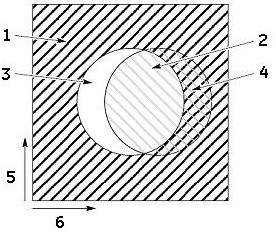
| Number | Description |
|---|---|
| 1 | Fat |
| 2 | Water |
| 3 | Void |
| 4 | Enhancement |
| 5 | Phase |
| 6 | Frequency |
Fat and water images are slightly displaced relative to one another, causing an artificial increase and decrease, respectively, at the locations of misalignment. The displacement artifact, which occurs in the frequency encoding direction, varies based on the field strength and receive bandwidth and frequency matrix scan parameters.
Acquiring images with a fat or water suppression technique reduces chemical shift artifacts because these artifacts are caused by relative shifts of fat from water. When one component is suppressed, there is nothing for the other component to shift away from.