

- 00000018WIA30732970GYZ
- id_400233861.4
- May 26, 2022 4:05:28 AM
ZIP
ZIP is a reconstruction technique. A 256×256 image can be reconstructed to a 512×512 or 1024 x 1024 matrix by using this zero-filling technique.
Zero-filling enhances the apparent image resolution, it does not create resolution. It is analogous to selecting a 256×128 acquisition matrix and displaying the images as a 256×256 matrix.
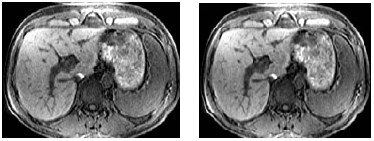
Use ZIP:
- to enhance resolution. It keeps the pixel size the same as the routine protocol (phase matrix and FOV the same and, therefore, no change in scan time).
- to recover some of the spatial resolution. Increase the FOV or decrease the Phase matrix, thereby increasing SNR
| Option | Applications | PSDs |
|---|---|---|
| ZIP 512 and ZIP 1024 |
| ZIP 512 is not compatible with:
ZIP 1024 is not compatible with:
|
ZIP tips
- ZIP 512 and 1024 enhance apparent image resolution. It can make truncation (Gibbs) artifacts more noticeable. Increasing the phase matrix value up to 256, or decreasing the FOV, can reduce this artifact.
ZIP 1024
- It produces a decrease in SNR, typically less than selecting a 512×512 acquisition matrix.
- It is not compatible with a No Phase Wrap value greater than 2.0.
- It is available for both single and quad-array processor configurations.
- Zip 1024 images take longer to reconstruct and require more disk storage space than a 256×256 or a 512×512 image.
- Zip 1024 images cannot be transferred to and displayed on a non-LX system.
- MIP images take a very long time to post process in MRA.
- It is not compatible with ASSET.
ZIP 512
- ZIP 512 has no effect if a frequency matrix value > 256 is selected (e.g., 512, 384, etc.) since 512 reconstruction is already used.
- It produces a small decrease in SNR as compared to a 256×256 matrix. However, the SNR of a scan with ZIP 512 is much higher than the same scan with a 512×512 acquisition matrix.
- ZIP 512 images take longer to reconstruct and require more disk storage space than 256 images. This additional reconstruction time and required storage space is identical to an acquired 512 image.