

- 00000018WIA30A7E870GYZ
- id_400214321.2
- Feb 11, 2022 5:29:57 PM
Respiratory Compensation
Respiratory Compensation uses a phase-sorting method to reduce phase ghosting from breathing motion when scanning in the chest or abdomen.
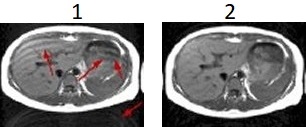
| Number | Description |
|---|---|
| 1 | Respiratory Compensation turned off. Note that the arrows point to motion artifact |
| 2 | Respiratory Compensation turned on. |
Use the Respiratory Compensation Imaging Option to reduce phase ghosting from breathing motion when scanning in the chest or abdomen.
- Use 2 or 4 NEX on patients with deep breathing patterns.
- If the patient’s breathing pattern cannot stay consistent during the acquisition, consider using a GRE, SSFSE, or EPI breath-hold method.
Choose the low or high sort Respiratory Compensation method.
- Low sort occurs when a No Phase Wrap value of 1.0 is selected.
Figure 2. Respiratory Compensation: low sort 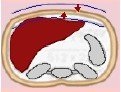
- High sort occurs when a No Phase Wrap value of 2.0 is selected. High sort doubles the PFOV, phase matrix, resulting in phase ghosts moved to outside the displayed FOV.
Figure 3. Respiratory Compensation: high sort 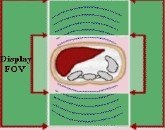
Respiratory Compensation:
- Adds a 1 ms delay to the cardiac gating trigger delay.
- Requires that the patient have a consistent breathing pattern during the acquisition; look for the message Resp OK. The system will scan without the message Resp OK, but there will be no Respiratory Compensation benefits.
- Slightly lengthens scan time.
- High-sort may increase vessel motion, therefore, program motion suppression techniques as needed.
- Cannot use a NEX > 4.