

- 00000018WIA30950970GYZ
- id_400237821.3
- May 10, 2022 3:51:14 AM
Ramp Sampling
Ramp Sampling increases the usable time the system has for acquiring the echo by sampling along the ramp-up, ramp-down, and the flat-top portions of the frequency gradient. The result is shorter ESP and the system moves from echo to echo faster.
Enter 1 (on) to reduce ESP, particularly when using high frequency matrix values. It is typically used for single-shot acquisitions with high-frequency values and to decrease geometric distortion.
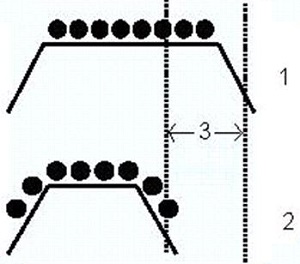
| Number | Description |
|---|---|
| 1 | Sampling of 8 data points without Ramp Sampling |
| 2 | Sampling of 8 data points with Ramp Sampling |
| 3 | Demonstrates the time saved when ramp sampling is turned On |
- The size of the frequency matrix and the usable time have a direct effect on the echo spacing. A 256 matrix uses half of the usable time as a 512 matrix.
- Ramp Sampling uses an effective Receive Bandwidth, which is displayed on the image and is a function of FOV, frequency matrix, and the number of shots.
- Receive Bandwidth is automatically set at scan time and cannot be changed. Typically, the system uses a Receive Bandwidth of +/- 62.5 or greater. Remember that as Receive Bandwidth increases, SNR decreases.