

- 00000018WIA30EDE870GYZ
- id_400222631.5
- Apr 13, 2022 3:30:34 PM
TR
TR (Time to Repeat or Repetition Time) represents the interval between successive excitation pulses of a slice in milliseconds. TR controls the amount of transverse magnetization that recovers to the longitudinal plane. If full recovery for any given tissue does not take place, it eventually becomes saturated.
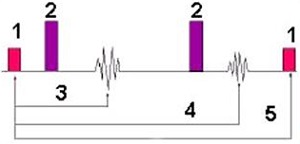
| Number | Description |
|---|---|
| 1 | 90° |
| 2 | 180° |
| 3 | TE1 |
| 4 | TE2 |
| 5 | TR |
Select a TR value that produces the desired image contrast.
- A short TR produces decreased SNR, decreased number of slices in multi-planar acquisitions, increased T1 contrast, and decreased scan time.
- A Long TR produces increased SNR, increased number of slices, increased PD/T2 contrast, and increased scan time.
- In conventional imaging, TR is a fixed value equal to a user-selected value. In cardiac-gated studies, however, it can vary from beat to beat depending on the patient’s heart rate.
Auto TR
Auto TR helps you select the optimum TR for the desired image contrast. It is only available with compatible pulse sequences. The first three Auto TR selections are automatically updated if a scan parameter that affects TR is changed, such as:
- Number of slices
- Frequency matrix
- Phase FOV
- FOV
- Slice thickness
- Slice spacing
- Bandwidth
For details, see Use TR Auto.