

- 00000018WIA3059E870GYZ
- id_400238001.3
- Apr 4, 2022 2:25:16 PM
Bandwidth
Select a Bandwidth to optimize Signal-to-Noise Ratio (SNR), Time of Echo (TE), number of slices, and chemical shift effect. Bandwidth can be selected for a dual echo Spin Echo acquisition.
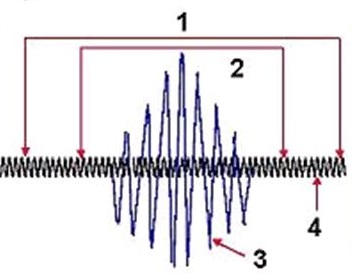
| Number | Description |
|---|---|
| 1 | 32 kHz |
| 2 | 16 kHz |
| 3 | Signal |
| 4 | Noise |
Bandwidth is also the frequency at which the system reads the echo. The faster the sampling rate, the shorter the time the frequency encoding (readout) gradient is applied.
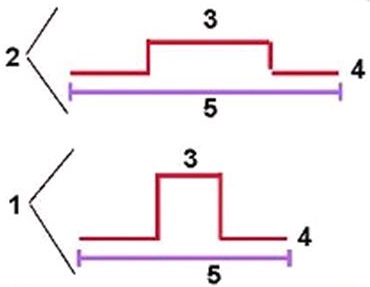
| Number | Description |
|---|---|
| 1 | 32 kHz |
| 2 | 16 kHz |
| 3 | Readout window |
| 4 | X-gradient |
| 5 | Time |
- As the bandwidth decreases, the SNR, chemical shift, minimum TE (and TR values for Fast GRE/SPGR applications), and motion artifact increase. As the minimum TE increases, the number of slices decreases.
- Halving the bandwidth is equivalent in SNR gain to doubling the Number of EXcitations (NEX). Decreasing the bandwidth is often used to increase SNR for T2-weighted scans.
- Increase the bandwidth to decrease the minimum TE, which decreases the echo space for FSE and EPI scans.
- Variable bandwidth narrows the receiver bandwidth to reduce the noise level and therefore increase the SNR.