
- 00000018WIA301AE870GYZ
- id_400251741.3
- Aug 15, 2022 12:21:59 PM
Fat shift direction
The Fat Shift Dir (direction) scan parameter is used to define the display direction from fat signal. Fat shift artifacts can obscure normal anatomy and thus swapping the direction of the fat shift artifact can minimize the impact of the artifact. The annefact /ghosting artifact is a peripheral signal artifact that appears as ribbons of signal smeared through the image. This artifact is caused from signals generated outside the desired FOV that are detected by the receiver. The Fat Shift Direction shifts the artifact but does not eliminate it and thus may improve the overall image quality for the area of interest.
It is typically used with the spine and pelvis scans.
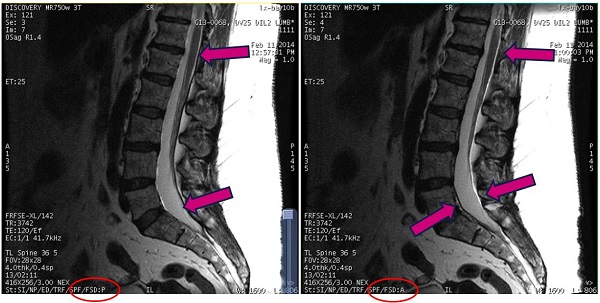
| Image | Description |
|---|---|
| Left | Fat Shift Direction set to Normal. |
| Right | Fat Shift Direction set to Reversed. |
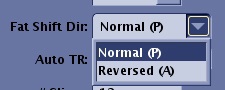
The Fat Shift Dir field is located on the scan parameter screen.
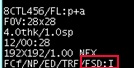
The fat direction is annotated in the lower left corner of the image as FSD:X where X indicates the direction: A (anterior), P (posterior), R (right), L (left), S (superior), I (inferior).
Considerations
- For scans acquired with the compatible PSDs, the scan slices, if they are multi-slices groups, must be parallel.
- For compatible PSDs, the Fat Shift Direction is tied to the frequency encoding direction.
- The selected Fat Shift Direction value depends on the value of the Frequency Direction. For example, for 2D FSE scans, the Fat Shift Direction should be on the same axis as the Frequency Direction, if the Frequency Direction is Superior/Inferior, Fat Shift Direction would be Superior or Inferior.
- The success of Fat Shift Direction depends on the uniformity of the anatomical area being scanned, patient orientation/setup, patient body shape, and the protocol and coil in use. The system is shimmed within specifications that provide optimal homogeneity; but keep in mind, that once a patient is placed in the magnet bore, the homogeneity is affected.
- Artifacts such as ghosting may occur when Fat Shift Direction is reversed for:
- Eye motion that may create ghost-like artifact in the brain.
- CSF pulsation or involuntary motion.
- Prostate imaging with a large coil may increase annefact artifacts and may be reduced by using a smaller coil.
- Extremity imaging.
- Consider the following when selecting other scan parameters:
- Avoid selecting half NEX.
- To reduce ghosting-like artifact, turn off User CV Blurring Cancellation for 1NEX.
- Select the receive coils that match the imaging FOV (i.e., LS45, LS56, CS12, etc.), which lessens the likelihood of the coil receiving peripheral signals that are generated outside the FOV.
- PROPELLER scans: the Effective Frequency Direction (Eff. Freq Dir) is associated with the frequency gradient. It usually corresponds to the image’s long axis.