
- 00000018WIA30ADE870GYZ
- id_400262791.4
- Mar 29, 2022 12:21:13 PM
TE and TE2
Time of Echo (TE) determines the time between the center of the first excitation pulse and the peak of the echo, which usually occurs at the center of the readout gradient.
TE2, available for two echo sequences, is the time between the center of the first excitation pulse and the center of the second readout.
TE controls the amount of transverse magnetization dephasing and is measured in milliseconds.
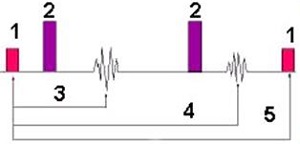
| Number | Description |
|---|---|
| 1 | 90° |
| 2 | 180° |
| 3 | TE1 |
| 4 | TE2 |
| 5 | TR |
TEs per Scan is the number of TEs that can be acquired per acquisition. It is frequently referred to as number of echoes.
Select the TE value that produces the desired image contrast.
- Short TEs produce increased T1/PD/blood flow contrast, increased SNR, and with multi-planar acquisitions, increased number of slices.
- Long TEs produce decreased number of slices, decreased SNR, and increased T2 contrast.
- Minimum TE selection obtains the minimum TE or a fractional echo. Fractional Echo is a technique that shortens the time in which the readout gradient (Gx) is applied so that shorter echo times can be achieved. Since the readout gradient is turned on for a shorter time, not all of the rephase portion of the echo is read, which may decrease the SNR. The loss in SNR may be offset by the shortened TE which allows less T2 decay and therefore greater SNR. The smaller the Field of View (FOV), the longer the minimum TE. Consider the following when using fractional echoes:
- When GRE is selected with a fractional echo, the system only reads about 60% of the echo.
- When a Spin Echo (SE) is selected with a fractional echo, the system uses a sliding scale from 60 to 100% for the amount of signal it reads. As the TE gets closer to a full echo, the system has more time to read the signal and therefore it approaches reading 100% of the echo.
- The longer the TE, the greater the magnetic susceptibility artifacts. This is especially true in GRE and EPI imaging.
- Using a fractional echo with lower bandwidths may compensate for SNR loss. As bandwidth decreases, SNR increases.
- Fractional Echo may affect the minimum values allowed for FOV, slice thickness, and matrix size.
- Min Full TE selection provides the shortest possible TE times without setting a fractional TE. This selection may increase SNR over a shorter TE acquired with a fractional echo technique.