

- 00000018WIA301EE870GYZ
- id_400226271.8
- Aug 19, 2022 5:21:39 PM
FSE-IR scan
FSE-IR employs the same technique used in FSE to speed up scan time, with an added IR technique that is primarily used for nulling the signal from fat.
The TI time in an FSE-IR scan is the primary driver for the image contrast. The TI value is set to the time it takes the tissue or structure to relax to the null point. The TI time is 140 to 170 ms for fat suppression.
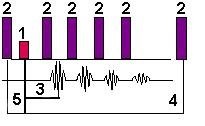
| Number | Description |
|---|---|
| 1 | 90° |
| 2 | 180° |
| 3 | TE |
| 4 | TR |
| 5 | TI |
Use FSE-IR to suppress the signal from fat in abdominal and extremity images and when you desire a more uniform fat suppression for large FOV or off-center FOV, FSE-IR is an excellent alternative to FSE Fat SAT.
Select these PSD selections to acquire a FSE_IR scan:
- Scan description: 2D Mode, FSE-XL pulse, IR Prepared Imaging Option.
General considerations
- Do not use an Inversion Recovery technique with contrast studies because enhancing pathology could be suppressed if the contrast shortened T1 corresponds to the null point.
Scan Parameters
- FOV: If the FOV is ≤ 16 and the slice thickness is ≤ 5, then the echo spacing may increase and there may be fewer slices per acquisition.
- NEX: If an odd NEX is selected, it may (although unlikely), result in reduced spatial resolution in comparison to the same scan parameters with an even NEX.
- : Consider swapping phase and frequency to minimize motion artifact.
- Slices: Increasing the number of refocusing RF pulses increases the SAR to the patient, which can limit the number of slices allowable for any given TR.
- TE:
 The maximum allowed value for TE2 may not match the maximum value shown adjacent to the TE text field because the system cannot allow for all possible parameter selections that affect the maximum TE. Therefore, you may find that the actual TE2 exceeds the posted maximum.
Imaging Options
- Flow Compensation: FSE-IR with the Flow Compensation Imaging Option may not provide benefits to the degree seen with conventional Flow Compensation Spin Echo. Therefore, swapping phase and frequency may be desirable to minimize motion artifact. If echo spacing remains short (for example, 16 msec or less), then swapping phase and frequency may not be necessary.
- Sequential: It is automatically selected with FSE-IR, even though an interleaved acquisition method is used when multiple groups are prescribed.
User CVs
Click the Advance tab to view the available User CVs. The CVs may vary based on the field strength and selected scan and imaging parameters.