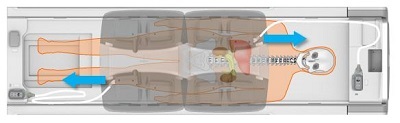
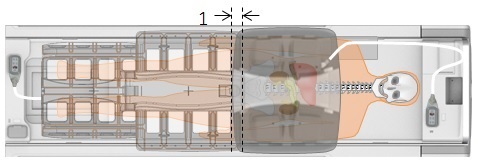
The system allows a finite set of multiple coils to be plugged into either the head or foot end coil connectors simultaneously.
Typically use for expanded superior/inferior anatomical coverage and improved patient workflow (obliviates the need to bring the patient out of the bore and reposition a coil).
Figure 1. Two AA coils in placeFigure 2. AA coil and PVA coil in place
Table 1. Image legend
Number
Description
1
Overlap: typically use a 5cm overlap
2
Pad
3
P4 port
Warning
The following general warnings should be followed when using cables and accessory connection equipment:
For medical devices that are labeled as MR Safe or MR Conditional consult the device manufacturer's documentation.
Use only GE or GE-authorized accessory coils, cables, monitoring and gating equipment that is labeled as MR Safe or MR Conditional (used within its conditions for use). Failure to restrict the use of such equipment not labeled for MR applications may result in patient burns or other injuries.
Use only accessories, coils, and cables that are in good condition. If you suspect that an accessory is not in good condition, discontinue its use and contact your GE Service Engineer.
Auxiliary devices indicated as MR Conditional may still cause patient injuries if the conditions for use are not explicitly followed. Never use equipment unless it is accompanied by the use instructions.
Remove unplugged surface coils or unused accessory devices from the magnet bore; a patient burn can result.
RF can heat non-compatible surface coils and MR Unsafe or MR Conditional (used outside of its conditions for use) gating cables, damaged surface coils/gating cables, surface coils that are not properly plugged in, and improperly routed cables can cause burns.
The use of cable-connected surface coils, photopulse sensor for peripheral gating (PG), or electrocardiogram (ECG) gating accessories for patient scanning can result in localized heating, leading to a burn or fire if proper scan preparation is not followed. The cables often extend into the high intensity region of the RF field and it is possible that induced electrical currents in the cables may cause arcing.
Always bring the cable directly out of the magnet bore with no slack. Place cables under the cushion whenever possible to separate the cable from the patient.
Keep the length of cable in the bore to a minimum. Avoid bending the cable 180° and route the cables out of the bore in the most direct way.
Route cables through the center of the magnet bore. Place cables under the cushion whenever possible to separate the cable from the patient. Routing near the sides of the bore increases the likelihood of cable heating (from induced currents).
Do not cross or loop cables. Arcing and patient burns could result.