

- 00000018WIA30AF7870GYZ
- id_400215251.3
- Feb 7, 2022 11:59:04 AM
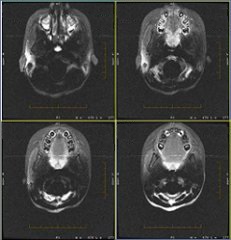
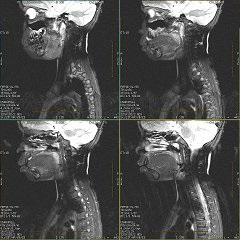
C-spine Fat SAT (Bulk Susceptibility) uniformity artifact
Poor chemical fat SAT uniformity can occur in C-spine imaging as a result of poor B)0 uniformity in the C-spine region. This is commonly referred to as a bulk susceptibility artifact.
B0 uniformity in the C-spine is dependent on the patient's shape and size, as well as on the positioning of the patient within the magnet. A static magnetic field can become inhomogeneous within a patient due to irregular geometry and the distribution of material magnetic susceptibility (which is the physical property that determines how "strong" a magnetic field will be within a material). The areas of inhomogeneity result in poor fat suppression.
In anatomical regions like the C-spine, variations in the B0 field exceeding 3 ppm can exist, which is approximately the fat-water separation range. Consequently, imaging sequences that employ chemical saturation to achieve fat suppression are extremely sensitive to B0 inhomogeneity and can result in regions exhibiting partial or incomplete fat saturation.
Troubleshooting tips
- Position the patient's neck as parallel as possible to the main magnetic field.
- Use a STIR sequence, typically with a 140 to 160 ms TI time, instead of chemical fat SAT.