
- 00000018WIA30618870GYZ
- id_400237371.4
- Aug 21, 2022 3:50:59 PM
PROPELLER
PROPELLER imaging significantly reduces the effects of motion artifact in routine T1 musculoskeletal, T2, T2FLAIR, T1 FLAIR, and PD scanning. PROPELLER also enhances CNR, contrast interfaces, and lesion conspicuity.
DW PROPELLER significantly improves image quality in the vicinity of bone/tissue or air/tissue interfaces, or around tissue/metal interfaces prone to creating susceptibility artifacts.
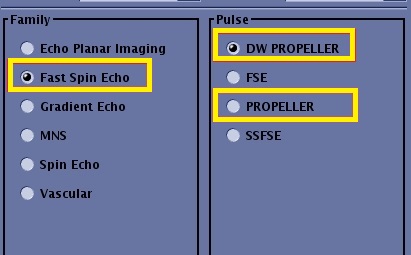
PROPELLER sequences are accessed under the Fast Spin Echo family, just like all 2D FSE-based pulse sequences.
PROPELLER is based on a rotating k-space acquisition. To understand how PROPELLER works, it is best to compare it to an FSE acquisition technique. FSE collects multiple phase encoded lines of k-space per TR period for a “shot” (based on the ETL). The process is repeated until all lines of k-space are filled. Note that there is only one shot acquired at the center of k-space. PROPELLER acquires multiple lines of k-space per TR for a "blade." The blades are rotated in k-space at incremental angles. The center of k-space is over-sampled resulting in a signal rich image.
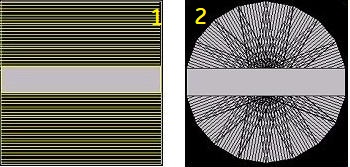
| Number | Description |
|---|---|
| 1 | FSE k-space |
| 2 | PROPELLER k-space |
K-space
PROPELLER fills k-space in a unique way. Rather than going at it line by line, k-space is filled with an arrangement of "blades." These blades are rotated in k-space at incremental angles. This method results in an over-sampling of the center of k-space, providing a more signal-rich image. The blades’ radial trajectory removes structured motion artifact, and redundant sampling enables the reduction of bulk patient motion artifacts.
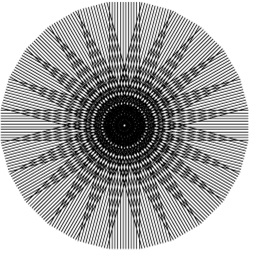
As raw data is collected, it’s checked for inconsistencies. Data is summed to create corrected k-space. The data is then transformed to image space and coil combinations are performed.
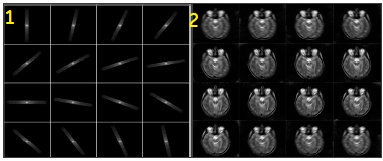
| Number | Description |
|---|---|
| 1 | Raw k-space data |
| 2 | Transformed data (right) |
Data Processing
PROPELLER’s ability to effectively reduce motion and susceptibility artifacts hinges in large part on the amount of data collected during a PROPELLER scan.
The redundant data collected in the center of k-space makes it possible for PROPELLER to perform several correction steps before final image reconstruction. After the initial signal is obtained, PROPELLER executes phase correction. Then the program performs three additional correction steps: rotation correction, translation correction, and correlation weighting.
All this additional data requires considerably more processing. PROPELLER uses intensive multi-channel image reconstruction and processing techniques, since it uses five times more processing steps than a conventional DWI acquisition.