
- 00000018WIA30355970GYZ
- id_400212721.2
- May 26, 2022 10:37:01 AM
STEAM CSI
STEAMCSI is a version of the STEAM sequence that acquires a stimulated echo from a localized volume. You can prescribe the localized volume manually or graphically. The basic sequence consists of three slice-selective 90° RF pulses and a set of crusher gradients. The crusher gradient areas are compensated to include the slice refocus, any phase encoding, and the readout dephase gradients.
STEAM CSI provides accurate voxel localization and water suppression. On the downside, a stimulated echo has an inherently lower SNR than a spin echo (as is acquired with the PRESS CSI sequence).
Consider this information when modifying STEAM CSI scan parameters. For specific scan parameter values, select a protocol from your GE or Site library.
- Scan selections: MRS Mode, Spectroscopy family, Steam CSI pulse.
- For a 2D STEAM CSI acquisition, see PROBE 2D CSI.
- For a 3D STEAM CSI acquisition, see PROBE 3D CSI.
- For a Single Voxel STEAM acquisition, see PROBE-S.
Phase cycling
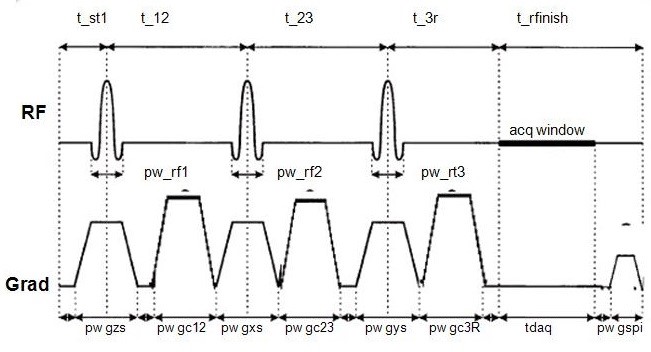
The STEAM CSI sequence supports phase cycles of 1, 2, or 8. In the two-step cycle, the first RF pulse is phase alternated by 180°. In the eight-step cycle, all three RF pulses are phase alternated. The choice of NEX in the Acquisition Timing area determines the phase cycle used. By default, the largest phase cycle that evenly divides NEX is used.
Sequence timing
| Pulse type | 90° Pulse width | Base | Hi or EchoSpeed |
|---|---|---|---|
| Spectra | 3600 µs | 19 ms | 12 ms |
| Voxel images | 3600 µs | 21 ms | 18 ms |
The 90° RF pulses have an effective bandwidth of 2367 Hz. Crusher gradient pulse widths are calculated for each acquisition prescription, subject to the minimum and maximum gradient pulse width limitations, and overall sequence timing limitations including the RF pulse lengths. The equation used is (all values are in µs):
PW_GC12 = TE/2 - FILTER_DELAY - 3*PW_RAMP - PW_RF3/2 - 200
- PW_GC12 is the pulse width of the crusher gradient
- TE is the echo time
- FILTER_DELAY varies depending on the spectral width and filter prefill (the default value for the 2500 Hz spectral width is 1016 µs)
- PW_RAMP is the width of a gradient ramp
- PW_RF3 is the width of the third slice selective RF pulse
As the echo time is reduced, and RF pulses with fewer side lobes and/or shorter crusher gradient pulses are employed, the quality of water suppression and voxel localization suffers. Use echo times longer than 20 ms and the eight-step phase cycle to achieve the best performance from the STEAM CSI sequence.
PROBE-S quantitative analysis
The PROBE-S sequence is a version of the STEAM CSI sequence. The special PROBE-S reconstruction process includes the reconstruction, display, and storage of a spectrum; and an analysis of five chemical species that are usually present in human brain spectra. Refer to Quantitative Analysis of the Data in PROBE/SVQ parameters for details of the algorithm used in the reconstruction and analysis.
Other sequence timing parameters
The time between the second and third RF pulses in the STEAM CSI sequence is known as the mixing time. To maintain consistency with previous versions of the STEAM CSI sequence, the mixing time is fixed at 13.7 ms. The mixing time can have a dramatic effect on the appearance of coupled resonances in proton spectra. You must consider mixing time effects when comparing spectra acquired with different mixing times, e.g., many published spectra have been acquired with a mixing time of 30 ms.
Auto Prescan considerations
STEAM CSI supports APS for all hydrogen data acquisitions. In this case, the APS process for the STEAM CSI and PROBE-S sequences adjusts TG, R1, R2, and the center frequency; optimizes water suppression; and invokes a voxel localized Autoshim routine to optimize the shim through a volume around the prescribed voxel. A constant TR (1500 ms) is used during APS to prevent system time-outs or excessively long prescan times when long repetition times are prescribed.
User CVs
Click the Advance tab to view the available User CVs. The CVs may vary based on the field strength and selected scan and imaging parameters.
- Automatic Water Suppression Optimization
- Number of Points
- ROI Edge Mask SAT
- Scan mode
- For Voxel imaging (Scan Mode = 0 or -1), select the shortest allowed value for TE and TR.
- Spectral Width
- Total number of scans