• Object ID: 00000018WIA30358970GYZ
  • Topic ID: id_40022559 Version: 1.5
  • Date: Mar 28, 2022 2:38:56 PM

Diffusion Tensor

READY View has two protocols to process Diffusion Tensor images to generate the parametric maps.

  • DTI protocol
  • DTI-Advanced protocol

The DTI protocol generates:

  • Average DC
  • Anisotropy Index
  • Fractional Anisotropy (FA)
  • Isotropic
  • Volume Ratio Anisotropy
  • Exponential Attenuation
  • T2-weighted Trace

The DTI-Advanced protocol generates:

  • Dxx Diffusion Coefficient
  • Dxy Diffusion Coefficient
  • Dxz Diffusion Coefficient
  • Dyy Diffusion Coefficient
  • Dyz Diffusion Coefficient
  • Dzz Diffusion Coefficient
  • Magnitude DC
  • Maximum Eigen value
  • Middle Eigen value
  • Minimum Eigen value
  • Relative Anisotropy
  • Surgace DC
  • Surface/Average Anisotropy
  • Volume DC
  • Volume/Average Anisotropy
  • Volume/Surface Anisotropy

Algorithms

In an anisotropic environment, the diffusion coefficient [D] that characterizes molecule mobility can be different along each direction of space. It can be modeled by a second rank tensor, represented by a 3x3 symmetric, positive and real matrix:
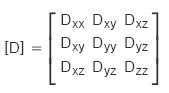


A diffusion-tensor data set contains, for each location, one or more reference T2* image(s) (b=0) and a number of acquisition images (from a minimum of 6 up to 300 images) each representing a different gradient orientation.

The Diffusion Tensor algorithm computes, for each pixel location, the six coefficients of the diffusion tensor from the data in the acquisition images.

The results are represented in the form of functional maps for isotropic image (or T2–weighted trace), average diffusion coefficient, exponential attenuation, fractional anisotropy, and volume ratio anisotropy.

Table 1. Diffusion Tensor algorithms
AlgorithmDescription
Coefficient functions
  • Dxx Diffusion Coefficient : It corresponds to the Dxx coefficient of the tensor matrix:
  • Dxy Diffusion Coefficient : It corresponds to the Dxy coefficient of the tensor matrix:
  • Dxz Diffusion Coefficient : It corresponds to the Dxz coefficient of the tensor matrix:
  • Dyy Diffusion Coefficient : It corresponds to the Dyy coefficient of the tensor matrix:
  • Dyz Diffusion Coefficient It corresponds to the Dyz coefficient of the tensor matrix:
  • Dzz Diffusion Coefficient: It corresponds to the Dzz coefficient of the tensor matrix:
Eigen value functions

Mathematically, the eigen value is the factor by which a linear transformation multiplies one of its eigenvectors. In an appropriate spatial reference frame, the diffusion tensor is diagonal (contains only three nonzero elements). These elements in diffusion tensor imaging are called the eigenvalues. The vectors characterizing the reference frame are the eigenvectors.

  • Maximum Eigenvalue : The diagonalization of the tensor matrix leads to the eigen system : { ( D1, e1 ), ( D2, e2 ), ( D3, e3 ) } where D1, D2, D3 are the eigenvalues with D1 < D2 < D3, and e1, e2, e3 are the normalized eigenvectors. The maximum eigenvalue corresponds to D3.
  • Middle Eigenvalue : The diagonalization of the tensor matrix leads to the eigen system : { ( D1, e1 ), ( D2, e2 ), ( D3, e3 ) } where D1, D2, D3 are the eigenvalues with D1 < D2 < D3, and e1, e2, e3 are the normalized eigenvectors. The middle eigenvalue corresponds to D2.
  • Minimum Eigenvalue : The diagonalization of the tensor matrixleads to the eigen system : { ( D1, e1 ), ( D2, e2 ), ( D3, e3 ) }where D1, D2, D3 are the eigenvalues with D1 < D2 < D3,and e1, e2, e3 are the normalized eigenvectors. The minimum eigenvalue corresponds to D1.
Invariant functions
  • First Invariant : It corresponds to the trace ( Dxx + Dyy + Dzz ) of the tensor matrix:

    Dxx + DYY + DZZ

  • Second Invariant : It corresponds to the surface area of the diffusion ellipsoid of the tensor matrix:

    DXX*DYY + DXX*DZZ + DYY*DZZ – DXY * DXY – DXZ * DXZ – DYZ*DYZ

  • Third Invariant : it corresponds to the volume of the diffusion ellipsoid of the tensor matrix:

    DXX * (DYY * DZZ – DYZ * DYZ) – DXY * ( DXY * DZZ – DXZ*DYZ) + DXZ * (DXY * DYZ – DXZ * DYY)

  • Fourth Invariant : It corresponds to the square of the magnitude of the tensor matrix:

    DXX * DXX + DYY * DYY + DZZ * DZZ + 2 * (DXY * DXY + DXZ * DXZ + DYZ * DYZ)

Diffusion functions

Diffusion measures the process of movement of a water molecule from an area of high concentration to an area of lower concentration. The functions defined under this category are :

  • Average Diffusion Coefficient: measures the mean diffusivity of water molecules inside tissues. It corresponds to:

    Average Diffusion Coefficient (ADC)= First Invariant /3

  • Surface Diffusion Coefficient : measures the mean diffusivity of water molecules inside tissues. It corresponds to:

    Surface Diffusion Coefficient (SDC) = sqrt (Second Invariant /3)

  • Volume Diffusion Coefficient : measures the mean diffusivity of water molecules inside tissues. It corresponds to:

    Volume Diffusion Coefficient (VDC) = cbrt (Third Invariant)

  • Magnitude Diffusion Coefficient : measures the mean diffusivity of water molecules inside tissues. It corresponds to:

    Magnitude Diffusion Coefficient (MDC) = sqrt( Fouth Invariant / 3)

Anisotropy functionsAnisotropy is the property of having different values when measured in different directions. The functions plugged under this category are:
  • anisotropy index: This index measures the anisotropy of the diffusion of water molecules. It corresponds to:

    ( (1e9 * MDC ) *( 1e9 * MDC) – (1e9 * VDC ) * (1e9 * VDC ) ) /2

  • fractional anisotropy: This index measures the anisotropy of the diffusion of water molecules. It corresponds to:

    sqrt ( 1.5 * ( 1.0 – ( ADC * ADC) / ( MDC * MDC) ) )

  • relative anisotropy: This index measures the anisotropy of the diffusion of water molecules. It corresponds to:

    sqrt ( ( MDC * MDC ) / (ADC * ADC) -1.0 )

  • surface/average anisotropy: This index measures the anisotropy of the diffusion of water molecules. It corresponds to:

    sqrt ( ( SDC / ADC -1 ) * (SDC /ADC -1.0) )

  • Volume / Average anisotropy: This index measures the anisotropy of the diffusion of water molecules. It corresponds to:

    sqrt ( ( VDC / ADC -1 ) * (VDC /ADC -1.0) )

  • Volume ratio anisotropy: This index measures the anisotropy of the diffusion of water molecules. It corresponds to:

    1 – ( VDC / ADC ) * ( VDC / ADC ) * ( VDC / ADC ) )

  • Volume / Surface anisotropy : This index measures the anisotropy of the diffusion of water molecules. It corresponds to:

    Sqrt ( ( VDC / SDC - 1 ) * ( VDC / SDC -1 ) )

Attenuation functions

Attenuation functions measure the property of weakening density of water molecules. The functions plugged in READY View under this category is:

  • Exponential attenuation: This corresponds to the "mean" attenuation of the signal:

    exp ( - bValue * ADC )

Isotropic image functions
  • Isotropic image : It corresponds to the geometrical "mean" attenuation of the signal weighted by the T2 image:

    Isotropic_value = 1

for each orientation

Isotropic_value = isotropic_value * pow ( T2_Signal * DW_Signal , 1.0 / ( double )_nOrientation )

Each pixel having a MR signal value lower than the threshold, without any diffusion gradient, is not processed.

T2W trace Functions
  • T2-weighted trace : It corresponds to the "mean" attenuation of the signal weighted by the T2 image :

    Average T2Value * exp ( - Bvalue * ADC)

  • Each pixel having a MR signal value lower than the threshold, without any diffusion gradient, is not processed.

DTI measurement units

The DTI functional maps have the following units of measurement.

Table 2. DTI measurement units
MapsUnits
DTI-Average Diffusion Coefficientm2/s
DTI-Isotropic ImageNone
DTI-Fractional AnisotropyNone
DTI-Volume Ratio AnisotropyNone
DTI-Exponential AttenuationNone
DTI-T2 Weighted TraceNone
DTI-Colored OrientationNone
DTI-Anisotropy IndexNone
Dxx Diffusion Coefficientm2/s
Dxy Diffusion Coefficientm2/s
Dxz Diffusion Coefficientm2/s
Dyy Diffusion Coefficientm2/s
Dyz Diffusion Coefficientm2/s
Dzz Diffusion Coefficientm2/s
Magnitude DCm2/s
Maximum Eigen valuem2/s
Middle Eigen valuem2/s
Minimum Eigen valuem2/s
Relative AnisotropyNone
Surface DCm2/s
Surface/Average AnisotropyNone
Volume DCm2/s
Volume/Average AnisotropyNone
Volume/Surface AnisotropyNone

READY View protocols that use DTI scan data

  • DTI
  • DTI-Advanced
  • MR Brain