- 00000018WIA30820870GYZ
- id_400259761.5
- Jan 26, 2022 8:57:21 PM
Spatial gradient
About this task
The spatial gradient is defined as how the B0 field changes with location: if the strength of the B0 field changes by 500 G between two locations 1 cm apart, the spatial gradient is 500 G/cm between those two points.
The shape of the SG field is quite different from the shape of B0. Like the B0 field, the spatial gradient’s shape is a symmetrical, three dimensional field that follows the cylindrical shape of the magnet. Figure 1 shows two spatial gradient isocontours. The green surface is at 400 G/cm. The blue is a higher spatial gradient at 700 G/cm. (The spatial gradient is the same at the front and back of the magnet – the back isocontours are removed for clarity in this figure.)
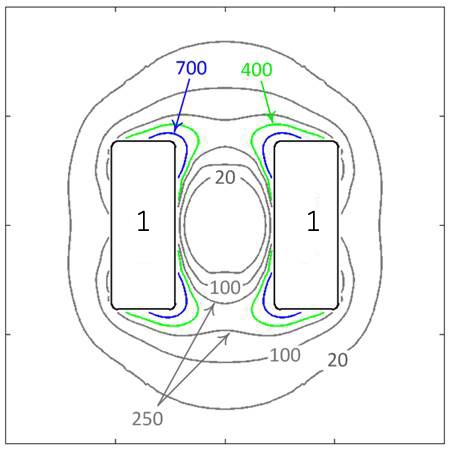
Figure 2 is a spatial gradient contour map (again, a two dimensional slice through the three dimensional field) shows the 700 and 400 G/cm contours. The contours are symmetrical around the centerline of the magnet, both side-to-side and end-to-end. Contours at 20, 100, and 250 are added, and they show three important behaviors of the spatial gradient field:
Step-by-step instructions
- Although the center of the magnet has very low spatial gradients, there is no way to get there without passing through higher spatial gradient regions. In this example, the spatial gradient reaches at least 250 G/cm on the way into the magnet.
Figure 1. Two isocontours of the spatial gradient 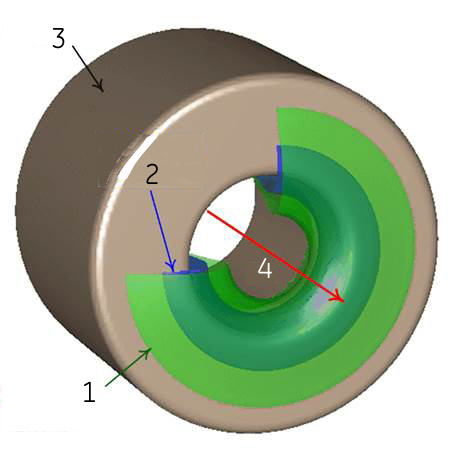
Table 1. Image legend Number Description 1 400 G/cm surface 2 700 G/cm surface 3 Magnet 4 B0 field Figure 2. A contour map of the spatial gradient