
- 00000018WIA30C22870GYZ
- id_400228681.9
- Jul 26, 2022 12:11:15 PM
Spatial magnetic field data
MR environment safety terminology
The MR Environment Safety Terminology is intended to help explain labeling matters for medical devices and other items that may be used in the MR environment to ensure the safe use of MR technology and to explain the possible changes in the MR compatibility of the tools and accessories used by the MR worker as a function of the value of the static magnetic field.
Terminology for defining the safety of items in the MR environment is provided in ASTM F2503 Standard Practice for Marking Medical Devices and Other Items for Safety in the Magnetic Resonance Environment. FDA recommended using the terminology MR Safe, MR Conditional, and MR Unsafe, defined in ASTM F2503 (FDA guidance document, “Establishing Safety and Compatibility of Passive Implants in the Magnetic Resonance (MR) Environment Document”).
Definitions
MR safe:  or
or 
An item that poses no known hazards resulting from exposure to any MR environment. MR Safe items are composed of materials that are electrically nonconductive, nonmetallic, and nonmagnetic. Note: An item composed entirely of electrically nonconductive, nonmetallic and nonmagnetic materials may be determined to be MR Safe by providing a scientifically based rationale rather than test data. Examples of MR Safe items are a cotton blanket or a silicone catheter.
MR Conditional: 
An item with demonstrated safety in the MR environment within defined conditions.
MR Unsafe: 
An item which poses unacceptable risks to the patient, medical staff or other persons within the MR environment.
| CAUTION | |
|---|---|
| Warning | |
|---|---|
| Warning | |
|---|---|
Magnet information
The peak main magnetic field (B0), peak gradient of the main magnetic field (grad(B0)), and the peak force product (main magnetic field times the peak gradient of the main magnet field [B0 grad(B0)]) and their spatial locations are provided in cylindrical coordinates with centers at magnet isocenter.
Definitions
- Peak main magnetic field (B0), maximum magnetic field magnitude at patient accessible locations.
For solenoid magnets these values typically lie on circles with radius R from the axis of the magnet on both the front and the back of the magnet at ±Z from isocenter.
- Peak gradient of the main magnetic field (grad(B0)).
The peak gradient of the static magnetic field, B0, is the maximum rate of change of the main magnetic field magnitude along any direction at a patient accessible location. For solenoid magnets these values typically lie on circles with (see table and figure below) radius R from the axis of the magnet on both the front and the back covers of the magnet at ± Z from isocenter.
Note: that the strength of time-varying gradients are small and not relevant to magnetic force considerations. - Peak force product (B0 grad(B0)).
The peak force product is the maximum product of B0 and grad(B0) at accessible locations. Note that maximum forces and torques will occur at this location. Only values in a patient accessible area with magnet covers in place are given in the table below. For solenoid magnets (see figure below) these values typically lie on circles with radius R from the axis of the magnet on both the front and the back of the magnet at ± Z from isocenter.
- Locations
Defined in cylindrical coordinates, (Z, R) with (Z=0, R=0) being magnet isocenter apply to both the front and back of the magnet (see table and figure below). For solenoid magnets the same maximum values occur at R, ± Z for all angles, i.e., the same peak values form a circle with radius R at ±Z.
- Translational Force
Force acting to move the center of mass of an object. Ferromagnetic objects in non-uniform magnetic fields experience translational forces.
- Torque
A pair of opposite forces some distance apart acting to rotate an object without changing the position of the center of mass. Asymmetrically-shaped ferromagnetic objects (such as needle-shaped objects) experience torques in magnetic fields.
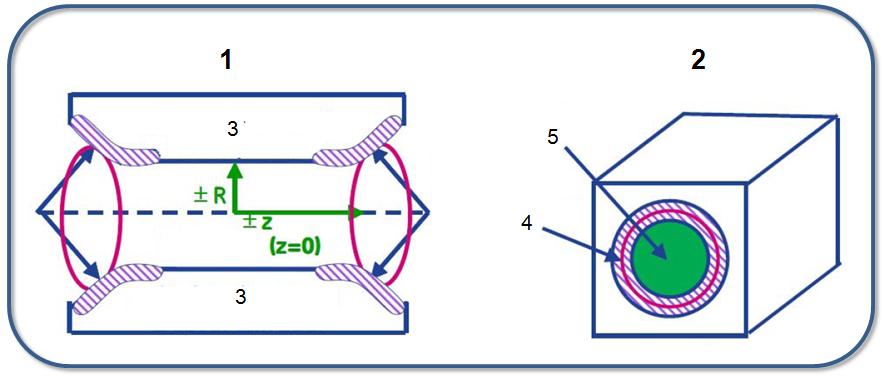
| Number | Description |
|---|---|
| 1 | Side cut-away view of magnet. |
| 2 | Front view of magnet. |
| 3 | Cylindrical magnet and cover (shroud). |
| 4 | Peak B Peak grad (B) Peak B* grad (B) Typically, peak B, peak grad (B), and peak B*grad(B) are close to the magnet covers in a patient accessible area and are symmetric for rotations about the long axis of the magnet (equal fields for (Z,R) along a circle centered on axis). The peak values are in the shaded regions. Specific locations (R.Z) are identified in table below. |
| 5 | Patient bore. |