

- 00000018WIA30E9D870GYZ
- id_400231591.4
- May 19, 2022 11:31:36 AM
VIBRANT
*VIBRANT is a trademark of General Electric Company
VIBRANT (Volume Imaging for BReast AssessmeNT), application is compatible with Breast coils and can be used either for bilateral or unilateral breast imaging.
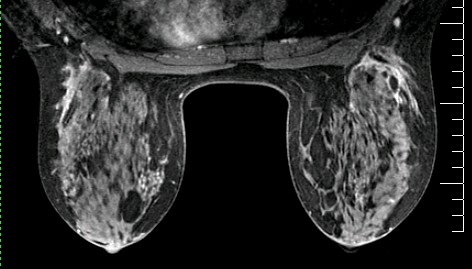
PURE and other image filter considerations
Keep the following important points in mind when using PURE or other image filter options with scans that are post processed or displayed in a viewer.
- The PURE feature changes the pixel intensity in the image to provide a more uniform image. This may lead to altered results when CADstream is used in conjunction with PURE for processing MR images. A modification to the CADstream difference threshold may be required. It is recommended to either disable PURE for dynamic studies or applying the PURE feature uniformly across all the dynamic series.
- The output of post processing can be modified with any change to the protocol. For optimal image quality, keep consistency with protocols and use the same type of filter or apply PURE for both pre and post contrast imaging.
- Refer to the CADstream operator manual or contact a Merge Healthcare representative regarding any change to your dynamic breast protocol and the use of PURE or other image filtering techniques.
Fat suppression techniques
There are three fat suppression techniques available:- SPECIAL
- SPECIAL and Adiabatic Spectral Inversion Recovery (ASPIR)
- Water Excitation (Spatial Spectral RF)
SPECIAL
On 1.5T and systems, SPECIAL is the most commonly used fat suppression technique.
From the PSD/Imaging Option screen, select the following:
- Mode: 3D
- Gradient Echo family
- VIBRANT Pulse
- From the ChemSat pull-down menu, select Special
- The TI is not selectable, but the value used during the acquisition is visible.
- To reduce a ripple-like artifact on coronal or sagittal reformatted images, consider increasing the slab slice (a minimum of 150 slices) and adjusting the slice thickness for the desired coverage. Increasing the slice count changes the number of segments and views per segment and can reduce the slice to slice variation in fat signal, thus reducing the artifact. Also, consider acquiring a sagittal or coronal images rather than using reformat to generate sagittal and coronal images.
Figure 2. Ripple-like artifact in sagittal reformat from axial source scan data 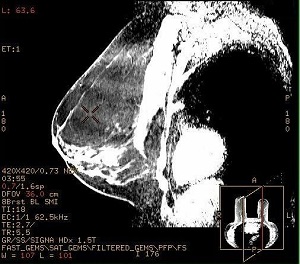
On 1.5 T or 3.0T systems, to use the ASPIR type-in PSD, from the PSD/Imaging Option screen, select the following:
- Mode: 3D
- Gradient Echo family
- VIBRANT Pulse
- PSD Name type-in field: efgre3d_aspir
- From the ChemSat pull-down menu, select Special
- The TI is not selectable, but the value used during the acquisition is visible.
- SPECIAL used with the type-in PSD Name efgre3d_aspir, applies an ASPIR fat suppression technique. The image acquisition is turned on at the inversion time when the fat signal is at the null point. ASPIR use a spectral-selective adiabatic RF pulse to invert only fat signal thus producing a more uniform fat suppression in comparison to SPECIAL. It also reduces the ripple-like artifact on the coronal or sagittal reformatted images. The adiabatic RF pulse is SAR intensive, which might result in a small TR increase compared to SPECIAL.