

- 00000018WIA30404870GYZ
- id_400242511.11
- Aug 5, 2022 12:30:53 PM
Stationary table
The stationary table includes an embedded high-density, posterior RF array. It can be raised and lowered to simplify moving the patient on and off the table. Although the terms cradle and table are often used synonymously, the cradle is a part of the table that moves the patient into and out of the magnet.
The patient table cradle is a Type BF applied part.
For details related to table specifications, see Technical specifications.
| Number | Description |
|---|---|
| 1 | Head end of table |
| 2 | Table pedals |
| 3 | Coil ports |
| 4 | Cradle release |
| 5 | IntelliTouch landmark strip and TDI Posterior array |
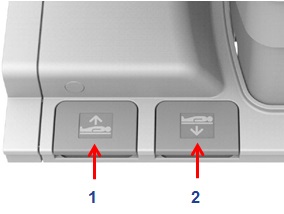
Table pedals
Up and down pedals used to raise and lower the table.
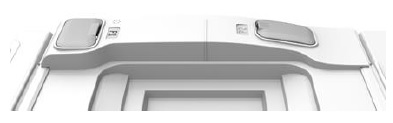
Coil ports
To connect coils to your MR system, see Connect coils.
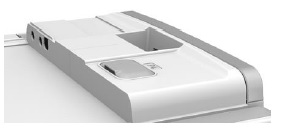
IntelliTouch
The landmark strip is located on either side of the table.
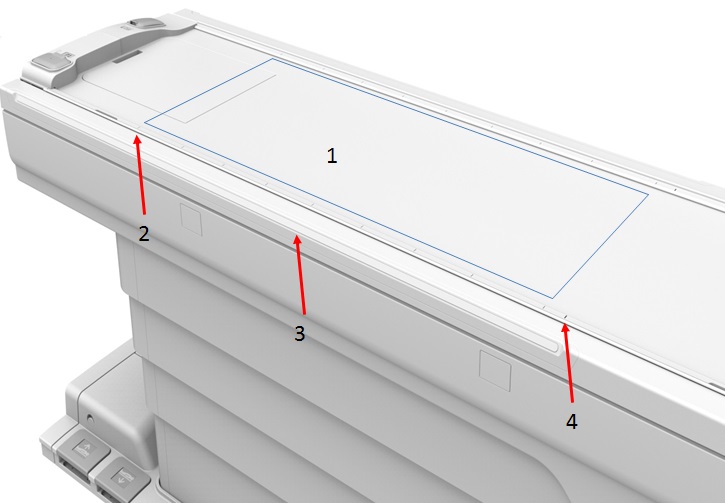
| Number | Description |
|---|---|
| 1 | The TDI posterior array is a 32-element phased array coil. It is designed to support parallel imaging in all 3 planes. |
| 2 | This line shows the coil area. |
| 3 | IntelliTouch Landmark strip. |
| 4 | Landmark limit. |
Cradle release handle
To remove the cradle from the magnet bore, see Cradle emergency release and re-engagement.
Patient security straps
The security straps can be slid into both sides of the table from either the head or foot end. Security straps across the arms, abdomen, or legs provides safety for the patient and help control patient motion.
PAC ports
There are four Physiological Acquisition Control ports:
- patient alert device
- respiratory bellow
- peripheral gating device
- ECG device
For patient alert details, see Patient alert.
For PAC details, see PAC-in-table connections.