All personnel should be aware of several factors to protect a patient from burns and peripheral nerve stimulation. The following steps should be observed by all personnel that position patients for scanning.
Step-by-step instructions
Remove any accessory devices from the bore of the magnet that are not required for the procedure.
This includes any unplugged electrically conductive materials such as surface coils, cables, etc.
Examine all patients with diapers or incontinence products, including adults, to make sure the patient has dry diapers on prior to the start of the scan.
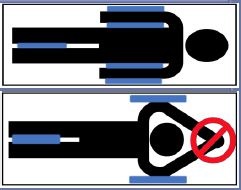
Position the patient to prevent direct contact between the patient's skin and the bore of the magnet or an RF surface coil.
Before connecting halves of a split coil, take care that the patient's body (for example, ear, jowl, neck, finger, hand, etc.) is not trapped or pinched by coil parts.
Padding is required. To help prevent patient burns, make sure that closed loops are not created by the body of the patient (e.g., clasped hands, hands touching the body, thighs in contact, and breast tissue contacting the chest wall).
Figure 1. Patient positioned with non-conducting pads
Use additional pads to immobilize the patient and make them comfortable.
Preventing patient warming is one of the most important safety measures you must take into consideration as you prepare a patient for an MR exam. Appropriate RF padding and proper patient positioning are the most effective means of preventing injury related to RF heating. The following are a few golden rules to remember as you position and pad your patients:
Only use GE-approved RF padding.
Use non-conductive padding that is at least 0.25 inches (0.635 cm) thick between the patient's skin and the magnet bore.
Appropriate padding must be used EVERY time without exception
Sheets and gowns are not a substitute for approved RF padding.
Never allow your patient’s skin to come in direct contact with the scanner bore or any surface coil or cable.
Never allow skin-to-skin contact.
If a patient does not fit in the MR scanner bore with the required padding, another modality should be used to scan the patient.
While some of these rules may seem a little tough to follow at times, remember that RF injury, which can in extreme cases include burns such as the one you see below, can happen very quickly and your patient may not have time to warn you in time to prevent an injury.
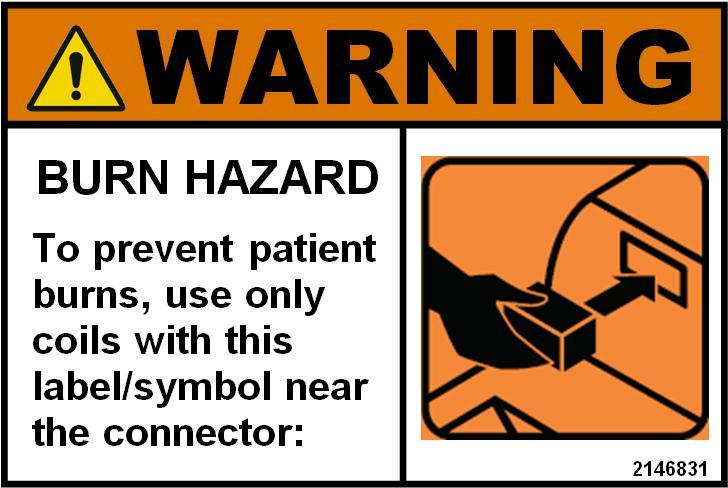
Only use approved RF coils that are not damaged.
Labels such as the one in the figure below, provide warnings about working with RF coils. Figure 2. Warning label
Before using the coil, check the integrity of the electrical insulation of the components or accessories of the device.
Keep electrically conductive material that must remain in the magnet bore from directly contacting the patient by placing insulation between the conductive material and the patient.
Place a clean cotton sheet over the coil and comfort pad so the patient's skin does not come in contact with the coil or the comfort pad.
Position RF cables down the center and directly out of the bore, without looping or crossing the cables.
Route the cables so there are no loops in any cables in the magnet. Cable holders are located on both side of the cradle near the edges. Use the appropriate gating cable for surface coil imaging.
Use only MR system recommended monitoring equipment, ECG leads, wires, electrodes, and other components and accessories.
For medical devices that are labeled as MR Safe or MR Conditional consult the device manufacturer's documentation.
Follow all instructions for the proper operation of physiologic monitoring or other equipment provided by the manufacturer of the device.
Test the patient intercom.
Make sure that the patient can hear you and you can hear the patient.
Enter the correct patient weight.
Correct weight entries maximize performance and help prevent excessive RF exposure.
Turn on the bore light and fan.
Lights turned on inside the bore can help alleviate feelings of claustrophobia.
A fan inside the magnet bore provides adequate air movement for the patient. Keep the fan on at all times.
Show the patient how to use the Patient Alert System.
Patients experiencing uneasiness or concern can squeeze the Patient Alert bulb.
When the Patient Alert bulb is squeezed, an alarm emits a signal.
Respond to bore temperature direction messages throughout the procedure.
The temperature messages are located in the message window on your console.
If the patient reports feeling warm, discontinue the procedure.