

- 00000018WIA30EF1870GYZ
- id_400256821.3
- Dec 16, 2021 10:58:18 AM
Instructions for use
IEC 60601-2-33 assumes that because no chronic effects from exposure to MR fields are known, worker safety limits are the same as for patients. However, it is prudent to minimize worker exposures. Exposure to gradient output can be minimized by keeping sufficient distance away (the distance required to complete necessary tasks in the scan room) from the gradient coils during scanning.
Workers must prevent ferromagnetic materials from entering the magnet room. Ferrous projectile hazards are a major safety concern. Note that some materials that are initially non-magnetic may become magnetic when subjected to a static magnetic field over a period of time. Motion in static magnetic fields (especially near large spatial field gradients) may induce metallic tastes, vertigo, nausea, and possibly flashes of light (magneto-phosphenes). These motion effects are considered to be non-hazardous, provided they do not cause the worker to fall.
Time-varying gradient magnetic fields may induce peripheral nerve stimulation if the worker intercepts sufficient time-varying flux. Peripheral nerve stimulation is non-hazardous unless it causes the worker to injure himself when startled by the effect. MR workers shall be adequately trained to minimize health effects of high static magnetic field as described above. Field plots of the maximum time-varying gradient |B| workers could experience outside the magnet bore is shown in the figure below.
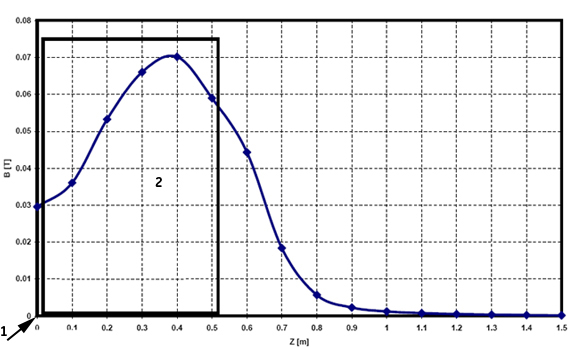
| Number | Description |
|---|---|
| 1 | Isocenter |
| 2 | Magnet from isocenter to front |
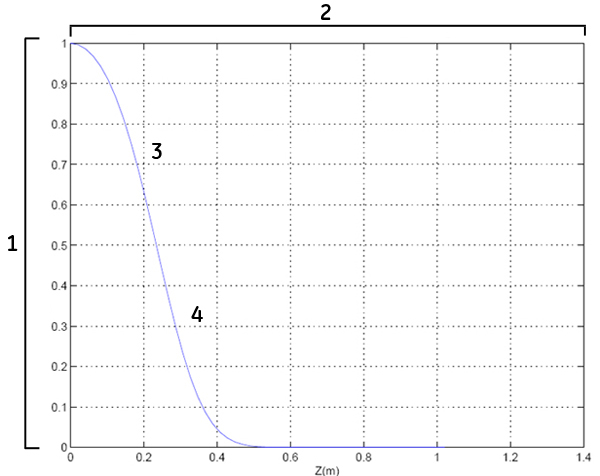
Radio frequency fields at sufficiently high levels may cause heating. Outside the magnet bore the radio frequency fields rapidly decay. Let B1 be the magnetic field strength of the radio frequency magnetic field. A plot of the square B1 normalized to its value at isocenter is shown in figure below. At most B1 at isocenter may produce the whole-body Specific Absorption Rate (SAR) limit. If as much of the body were exposed outside the bore then the graph below shows the scale factor for each Z location. This is a very conservative estimate of SAR since the total flux into the body is likely to be much smaller.
| Number | Description |
|---|---|
| 1 | Square of B1 normalized to isocenter. |
| 2 | Square of B1 normalized to isocenter for body birdcage coil on axis. |
| 3 | The point (0.707) at which RF transmission is reduced by 3 dB from maximum at isocenter. |
| 4 | The point (0.316) at which RF transmission is reduced by 10 dB from maximum at isocenter. |