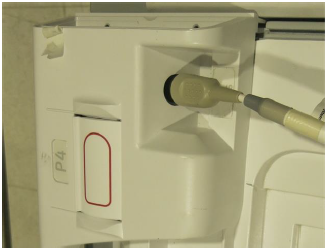
Various equipment and accessories are used in the MR environment for specific types of examinations that include cables and require connections to the MR system or the patient.
Application of MR conditional physiological monitoring and sensing devices to the patient should be made under your organization's direction and is the sole responsibility of your organization.
To avoid trip hazards, you should install yellow and black trip hazard indicator covers over any cables routed on the ground of the equipment room.
Warning
The following general warnings should be followed when using cables and accessory connection equipment:
For medical devices that are labeled as MR Safe or MR Conditional consult the device manufacturer's documentation. IEC 60601-1-2: 5.2.2.1, IEC 60601-2-33: 201.7.9.2.101 (l)
Use only GE or GE-authorized accessory coils, cables, monitoring and gating equipment that is labeled as MR Safe or MR Conditional (used within its conditions for use). Failure to restrict the use of such equipment not labeled for MR applications may result in patient burns or other injuries.
Use only accessories, coils, and cables that are in good condition. If you suspect that an accessory is not in good condition, discontinue its use and contact your GE Service Engineer.
Auxiliary devices indicated as MR Conditional may still cause patient injuries if the conditions for use are not explicitly followed. Never use equipment unless it is accompanied by the use instructions.IEC 60601-2-33: 201.7.9.2.101 (j)
Remove unplugged surface coils or unused accessory devices from the magnet bore; a patient burn can result.IEC 60601-2-33: 201.7.9.2.101 (j)
RF can heat non-compatible surface coils and MR Unsafe or MR Conditional (used outside of its conditions for use) gating cables, damaged surface coils/gating cables, surface coils that are not properly plugged in, and improperly routed cables can cause burns.
The use of cable-connected surface coils, photopulse sensor for peripheral gating (PG), or electrocardiogram (ECG) gating accessories for patient scanning can result in localized heating, leading to a burn or fire if proper scan preparation is not followed. The cables often extend into the high intensity region of the RF field and it is possible that induced electrical currents in the cables may cause arcing.
Always bring the cable directly out of the magnet bore with no slack. Place cables under the cushion whenever possible to separate the cable from the patient.
Keep the length of cable in the bore to a minimum. Avoid bending the cable 180° and route the cables out of the bore in the most direct way.
Route cables through the center of the magnet bore. Place cables under the cushion whenever possible to separate the cable from the patient. Routing near the sides of the bore increases the likelihood of cable heating (from induced currents).
Do not cross or loop cables. Arcing and patient burns could result.
In addition to the warnings above, there are specific warnings related to Cardiac Gating Equipment and Accessory Coils you need to understand to maintain a safe MR environment.
Cardiac gating equipment
Electrocardiogram (ECG) gating (triggering) may be performed in an MR environment to synchronize the MR scan acquisition with the patient’s heart beat. Only MR Safe and MR Conditional (used within its conditions for use) electrodes and high-impedance leads should be used in the MR environment to ensure patient safety. For medical devices that are labeled as MR Safe or MR Conditional consult the device manufacturer's documentation.The ECG triggering feature on the system should only to be used for cardiac gating and must not be used for patient monitoring. It is important to use only GE recommended disposable electrodes and GE High Impedance ECG Cables.
Figure 1. Patient comfort pad positioned underneath ECG cable connected to the ECG port_for eXpress mobile table
Warning
Observe the following warnings when using ECG or peripheral gating:
The MR cardiac gating feature is intended for use solely in acquiring MR images using cardiac gating/triggering, not for physiological monitoring. The patient’s condition may not be reflected, resulting in improper emergency treatment.
Do not use monitoring equipment when conductors are in the bore and touching the patient; burns can result.
Do not use leads with broken shields or exposed conductors. Only use accessories in good condition. If you suspect that an accessory is not in good condition, discontinue its use and contact your GE Service Engineer.
Check to see that the cardiac or peripheral gating cable does not pass under or near the surface coil or surface coil cable.
Check to see that only the peripheral gating sensor touches the patient. Keep cables from coming in contact with the patient.
Do not use equipment that has not been specifically tested and approved for use in the environment of a MR system.
Physiological monitoring and sensing devices should be used solely under the operators direction and it is their responsibility to ensure patient safety.
Warning
Do not use waveforms for physiological monitoring. Patient condition may not be reflected, resulting in improper treatment.
Warning
Do not use expired or dried electrodes. They do not properly conduct the signal, which can lead to image degradation, create intermittent triggering, and can cause burns to the patient.
Warning
GE High Impedance ECG Cables shall only be used under the conditions described below.
Non-clinical testing has demonstrated this device is MR Conditional and can be scanned safely only under the following conditions:
Maximum static magnetic field: 3.0T
Maximum spatial gradient: 1650 Gauss/cm
Maximum whole body average SAR: 4W/kg for 60 minutes of scanning produced a temperature of less than 41°C
The ECG lead signal may be visible in the images
Accessory coils
It is important you familiarize yourself with the operating instructions for each accessory coil used in your MR environment. Follow the recommended guidelines and precautions by the manufacturer.
Warning
Observe the following warnings when using surface coils:
Do not use surface coils with exposed coils or damaged insulation. Skin contact with metal conductors can cause burns.
Do not allow the surface coil cable to touch the patient; patient burns can result. Use a thermal resistant material or pad to keep the cable from touching the patient.
When using the 1.5T Breast Coil, make sure the patient’s back and arms do not touch the magnet bore. Use thermal resistant material or padding between the patient and the magnet to prevent burns that could be caused by patient contact with the interior of the magnet bore.