

- 00000018WIA3013F870GYZ
- id_400224751.2
- Mar 16, 2022 2:38:41 PM
Focus
Use Focus to acquire brain, spine, body and extremity images with the following PSDs:
- 2D DWI and DTI
- 3D FSE
- 3D FRFSE-XL
- 3D CUBE
- 3D Cube T2 FLAIR
- 3D Cube DIR
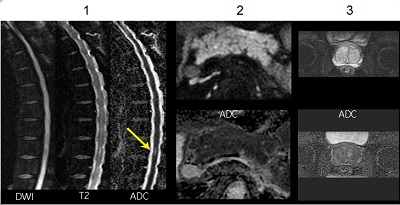
Focus is an excitation method that can be combined with other MR acquisition techniques to image a reduced FOV. Compared with conventional RF excitation, Focus reduces the FOV in the phase encode direction within the imaging plane and does not cause the conventional phase wrap artifact. Focus is particularly useful in exams where the region of interest is small in the phase encode direction, for example spine, prostate and pancreas. The reduction in phase FOV can be achieved, for example, by 2D spatially selective excitation as in Focus DWI or with outer volume suppression as with Focus CUBE. For more details regarding Focus with Cube, see Cube and Cube T2 FLAIR scan.
The 2D RF pulse used by Focus DWI is sensitive to hardware delays, which can result in image degradation in areas that are far away from isocenter. The image degradation can manifest as poor signal homogeneity and/or dark bands in the image. Care should be taken to image close to iso-center in the phase and slice direction when possible.
Because of the sensitivity of EPI acquisitions to B0 inhomogeneities, placement of a local shim box around the region of interest is also highly recommended to achieve better image quality.
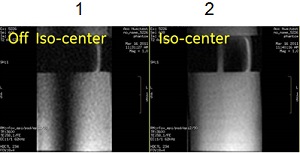
Image are annotated: FOC in the lower left corner of the image and on the Series text page.
Other PSD scan parameters, imaging options and saturation techniques are available if they can be selected; if not, they either don't appear or are grayed-out.
| Number | Description |
|---|---|
| 1 | DWI spine images with Focus. |
| 2 | DWI pancreas images with Focus. |
| 3 | DWI prostate images with Focus. |
| Number | Description |
|---|---|
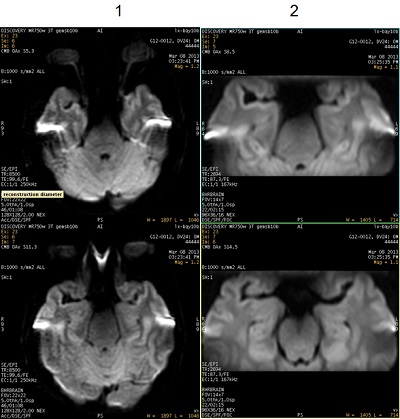
| 1 | DWI images acquired with Excitation Mode: Selective. Note the increased images magnetic susceptibility distortion effect. |
| 2 | DWI images acquired with Excitation Mode: Focus. Note the increased resolution due to less magnetic susceptibility distortion effect. |