

- 00000018WIA309A5970GYZ
- id_400261211.1
- Mar 1, 2022 5:49:05 PM
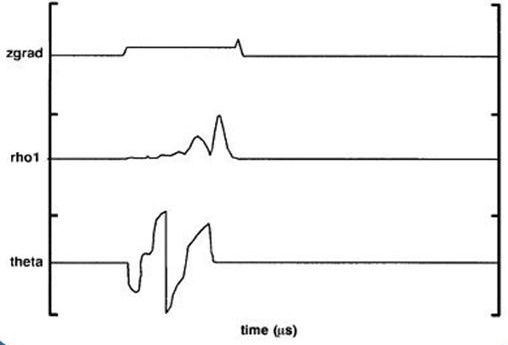
Spin Echo (MRS) PSD
The Spin Echo (MRS) sequence collects an echo from a prescribed slice, or set of slices, using a self-refocused spin echo RF pulse pair. The RF pulse pair has a fixed TE of 2.5 ms, and effective flip angles of 20, 30, 45, 60, and 90°. Furthermore, the RF pulse pair is optimized for the acquisition of phosphorus spectra from 3×3×3 cc CSI volumes at a minimum TE and without the need for any baseline correction. The spin echo RF pulse pair is selected from the Excitation menu on the scan parameters Detail screen. Although not normally used, a hard pulse option (Excitation Mode set to Non-Selective), is available for sequence setup and testing; in this mode, a FID is collected from the entire volume of the receive coil.
The Spin Echo (MRS) sequence is most suitable for performing multi-nuclear CSI studies when a very short echo time is required for species with short T2 relaxation characteristics.
Background
Acquisition modes
The Spin Echo (MRS) sequence supports the standard data acquisition modes: image, average, accumulate, and CSI (although the 3D CSI acquisition mode is not available). Multi-slice acquisition is available in all data acquisition modes. The short, fixed TE of 2.5 ms limits the use of phase encoding to the gradient(s) not used for slice selection. This means that:
- 1D and 2D CSI phase encoding is possible with axial, sagittal, and coronal slice prescriptions – one gradient is used for slice selection
- only 1D CSI phase encoding is possible with single oblique slice prescriptions – two gradients are used for slice selection
- no CSI phase encoding is possible with a double oblique slice prescription since all three gradients are being used for slice selection
RF pulse pair
The spin echo RF pulse pair design reduces required RF power when compared to single self-refocusing pulses, but requires a minimum of two excitations (NEX = 2) to obtain an optimized slice profile. The effective bandwidth of the spin-echo pulse pair is 1200 Hz (the Bandwidth is 2000 Hz if the Flip Angle is 30°). The design of this and similar spin echo RF pulse pairs is discussed in K.O. Lim, J. Pauly, P. Webb, R. Hurd and A. Macovski, Magnetic Resonance in Medicine, 32, 98-103 (1994).
Auto Prescan
Auto Prescan results for the Spin Echo (MRS) sequence are not truly optimized for the spin echo RF pulse pair. The TG should be determined manually on the Spectroscopy Prescan screen. A constant TR (1500 ms) is used during APS to prevent system time-outs or excessively long prescan times when long TR times are prescribed.