

- 00000018WIA307A5970GYZ
- id_400243931.2
- Mar 1, 2022 5:40:33 PM
FID PSD considerations
FID CSI (MRS) sequence is a one-pulse sequence that uses either a non-slice-selective (hard) pulse to acquire a FID from the sensitive volume of the receive coil, or a slice-selective (soft) pulse to acquire a FID from a desired slice. It acquires a spectrum (non-hydrogen nuclei spectroscopic data). Rather than manually adjusting the shim across the slice, the shim is optimized with the Auto option for the shim selection. The Selective or Non-Selective RF pulse is selected from the Excitation Mode menu located on the scan parameters Detail screen.
The FID CSI sequence is most suitable for performing multi-nuclear CSI studies when a very short echo time is required for species with short T2 relaxation characteristics. First order phasing is required for spectrum analysis.
Background
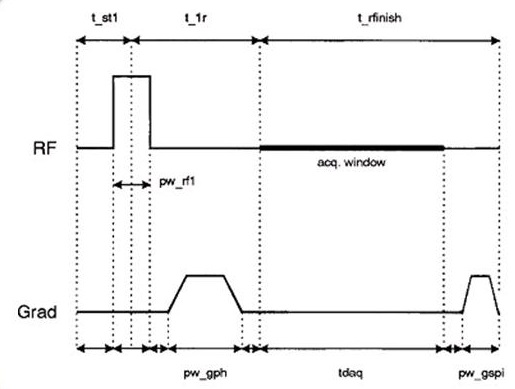
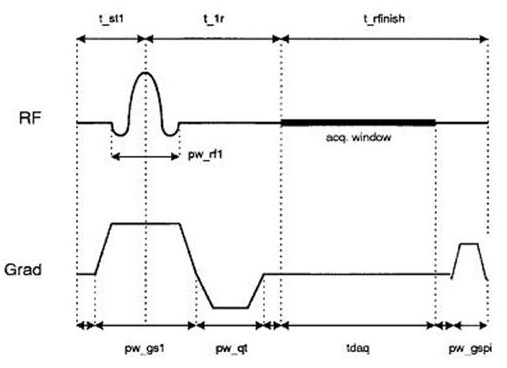
With FID CSI, you can choose to collect a FID either from the entire sensitive volume of a coil or from a prescribed set of slices by setting the rf pulse User CV to either 0 (entire volume) or 1 (slice selective soft pulse). In the first case, a rectangular (hard) RF pulse is applied to excite the volume. If you select CSI, phase encoding gradients are applied as prescribed along one, two, or three axes. If soft is chosen, a selective RF pulse is applied in the presence of a slice selective gradient, and a following slice rephasing gradient is applied. In a CSI acquisition, phase encoding gradients are applied at the same time as the rephasing gradient. In either case, data collection starts as soon as all pulses are completed. The slice-selective mode can perform multi-slice acquisitions.
Phase cycling
The FID CSI (MRS) sequence supports phase cycles of 1 or 2. In the two-step cycle, the 90° pulse is phase alternated by 180°. Your NEX selection determines the phase cycle used: when NEX is even, the phase cycle is 2; otherwise, it is 1.
Acquisition mode
FID CSI supports the standard data acquisition modes: image, average, accumulate and CSI. Multi-slice acquisition in all modes is permitted when the slice selective option is used. Interleaved slice acquisition ordering is used with all multi-slice acquisitions. The sequence cannot perform multi-pass acquisitions. Slices may be prescribed graphically or manually, as with imaging studies.
Sequence timing: RF and gradient pulse widths
For the FID CSI sequence, the CSI phase encoding gradient pulse width is 1.0 ms. The width of the RF excitation pulse used in the sequence depends on whether you have requested the hard or soft (slice selective) RF pulse. That is, it depends on the value of the rf pulse User CV (0 or 1, respectively). The width of the hard RF pulse is 500 µs; the width of the slice selective pulse is 1800 µs. A minimum phase RF pulse with an effective bandwidth of 2288 Hz is used for slice selection.
The acquisition delay from the effective center of the RF pulse to the start of the data acquisition depends on your choice of the data acquisition mode. Sequence timing parameters differ for image acquisition, for CSI data acquisition, and for spectrum acquisition. The number of sampling points of delay is given by the value of an internal control variable called “dwells.” The “dwells” value can be used to estimate the first order phase correction necessary to properly phase the spectrum. The possible values of “dwells” are 0.835 and 5.64 points, respectively, for a single spectrum or CSI spectra acquired with a hard RF pulse; and 3.69 and 8.00 points, respectively, for a spectrum or CSI spectra acquired with the soft RF pulse.
Auto Prescan
FID CSI supports APS for all hydrogen data acquisition. If the nucleus is hydrogen, the APS process adjusts TG, R1, R2 and the center frequency. Autoshim runs on the selected slice or at isocenter. A constant TR (1500 ms) is used during APS to prevent system time-outs or excessively long prescan times when long repetition times are prescribed.