

- 00000018WIA30F9F870GYZ
- id_400251911.0
- Jun 17, 2021 1:01:28 PM
ASPIR considerations
Consider the following with SPECIAL and 2DFSE-ASPIR:
- ASPIR use a spectral-selective adiabatic RF pulse to invert only fat signal thus producing a more uniform fat suppression in comparison to non-ASPIR techniques. The image acquisition is turned on at the inversion time when the fat signal is at the null point.
- There is an approximately 30% increase in scan time to account for the ASPIR inversion pulse.
- ASPIR is more robust for B1 inhomogeneities when compared to Chemical Fat Saturation (CFS). ASPIR is particularly appealing when acquiring scans in anatomical areas such as the pelvis where B1 inhomogeneities often cause non-uniform fat suppression with a CFS technique. The pelvis images in Figure 1 compare the results of Chemical Fat Saturation and ASPIR. Note the apparent areas of non-uniform Fat Sat suppression in the CFS image. The ASPIR image has improved fat suppression, but the scan time increased approximately 30%.
Figure 1. Chemical fat saturation compared to ASPIR in the pelvis 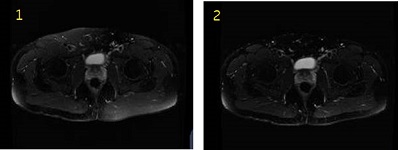
Table 1. Image legend Image acquired with CSF technique. Note: the very apparent areas of non-uniform fat suppression.Image acquired with ASPIR technique. Note: the uniform fast suppression. The scan time was increased approximately by 30%. - 2D FSE ASPIR is only available with T2-weighted and PD-weighted 2D FSE protocols that have a TR greater than 1500 ms and an ETL greater than 5.
- Fat SAT Efficiency can be used to modify the amount of fat saturation. As the value increases, fat becomes darker on the image. As the fat saturation value increases, more fat is suppressed.
- SPECIAL when used with VIBRANT type-in PSD Name efgre3d_aspir, COSMIC, Inhance 3D Inflow IR, SSFSE, 2D FIESTA on 3.0T systems, and Diffusion Weighted Imaging uses an ASPIR fat suppression technique.
- Cube used with Fat SAT or Fat Classic uses an ASPIR fat suppression technique.